
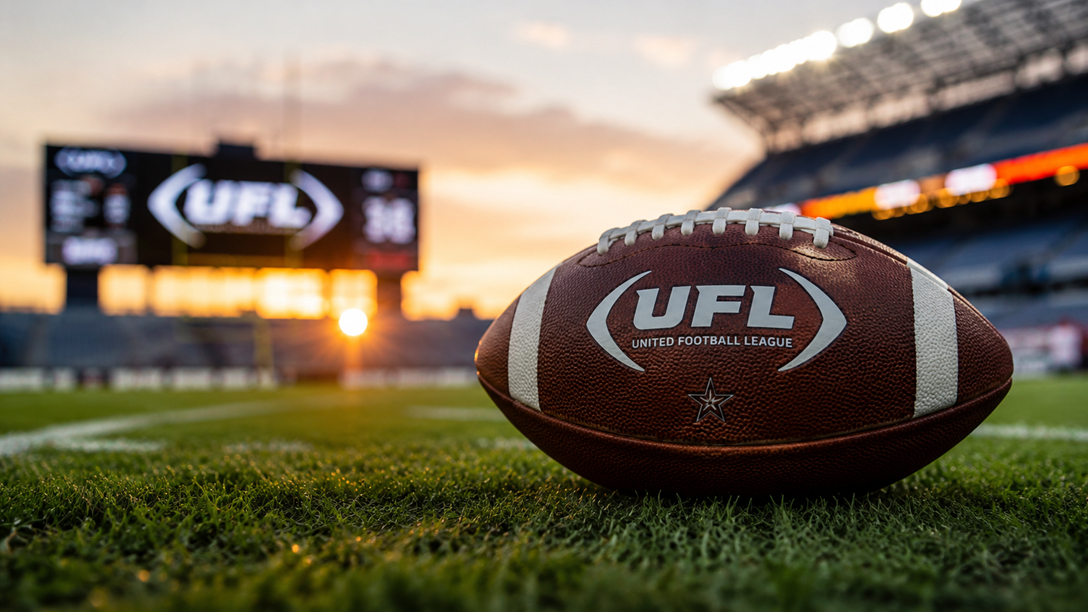
The UFL can keep growing, but the 2026 season has already shown the difference between expansion and health. The league added Columbus, Louisville, and Orlando for its third season, moved Dallas to Toyota Stadium in Frisco, rebranded Houston as the Gamblers at Shell Energy Stadium, and kept Birmingham, D.C., and St. Louis as its older spine. That is real movement, not a press-release mirage, but through Week 9 the standings also tell a smaller truth: Orlando is 7-2, St. Louis is 6-3, Louisville and D.C. sit at 5-4, while Dallas, Houston, and Columbus have already been eliminated at 3-6. Growth has a scoreboard.
The New Map Finally Looks Intentional
The strongest 2026 move was not the number of teams; it was the move into stadiums that look sized for spring football rather than empty NFL bowls. Columbus at Historic Crew Stadium, Louisville at Lynn Family Stadium, Orlando at Inter&Co Stadium, Dallas at Toyota Stadium, and Houston at Shell Energy Stadium all point toward the same business lesson: better a tight 10,000-seat night with noise than 11,000 scattered bodies in a cavern. The UFL also dropped the old two-conference setup and went to a single eight-team table, with the top four advancing to the playoffs. Cleaner. Easier to follow.
St. Louis Still Carries the Noise
St. Louis remains the league’s loudest proof of concept. The Battlehawks drew 31,191 for their Week 1 win over D.C. at The Dome at America’s Center, and that crowd still stands apart from most other UFL gates this spring. The football helped: Ricky Proehl’s team has stayed in the playoff picture at 6-3, and the building sounds different when the Battlehawks get an early stop instead of chasing a dead second quarter. The small thing that matters on television is the lower-bowl shot after a third-down sack; St. Louis gives the league that visual more reliably than any other market.
The TV Bet Is Bigger Than the Turnstiles
The UFL’s best expansion tool may be television discipline rather than another city announcement. The 2026 schedule put all 43 games across FOX, ABC, ESPN, ESPN2, FS1, and the ESPN App, with FOX bringing back a weekly Friday night slot and the league saying 70% of all games would air on ABC or FOX. That gives casual fans a habit, and habit is worth more than one busy social post in March. The league cannot sell itself as a national property if its schedule feels hidden; Friday night football gives the sport a shelf.
Betting Interest Follows the Live Window
Spring football gets a clean little window after the NFL Draft, before August eats the room again. That is when UFL people start acting like depth-chart sickos: who is taking first-team snaps, which quarterback got pulled after two series, which coach keeps going for it on fourth-and-2 instead of taking the three. During those games, gambling games (Arabic: العاب مراهنات) can sit on the same phone as UFL moneylines and live totals, but the useful read still comes from the football itself. Watch the guards in the inside zone. Watch the red-zone play-calling. Watch whether a coach sends the kicker out from 48 or keeps the offense on the field. One missed conversion can wreck a ticket, a drive, and half a quarter of momentum.
Attendance Is the Part Nobody Can Spin
The league’s problem is not whether people understand the product. The problem is whether enough people in enough cities buy tickets after the novelty game. Louisville opened with 14,034 against Birmingham and has kept a local pulse, while Columbus drew nearly 15,000 for its first home game against D.C. before later numbers settled closer to the league’s middle. Houston has been harder work, even with the Gamblers name and a better-sized venue, and Dallas still has to prove Frisco can become a spring-football habit rather than a curiosity. The on-field product has had real moments — Orlando’s 16-0 win at Birmingham in Week 4, D.C. dropping 45 on Houston in Week 3, Louisville’s overtime win in Houston — but good football still needs repeat customers.
Oklahoma City Is the Next Real Test
Oklahoma City is the part of the story that feels less rushed, which is rare in spring football. The UFL says the city is lined up for 2028 at the downtown MAPS 4 Multipurpose Stadium, a 10,000-seat building that at least starts with the right scale. That gives the league time to do the boring work: local sponsors, ticket deposits, youth-football nights, and a name people will actually say out loud. During that runway, fans tracking odds, playoff movement, and roster churn may download the Melbet app (Arabic: تحميل تطبيق melbet) as June games start to tighten and every injury note shifts the market. The league version of the lesson is not much different: do not sell noise before there is a crowd to make it. OKC has to feel claimed before it feels big.
The Next Expansion Cannot Be Cosmetic
The UFL does not need 16 teams by next spring. It needs eight teams that feel stable, four or five markets with real local culture, and a TV schedule that does not make fans hunt for games. Orlando at 7-2 gives the 2026 reset a strong new-market story, St. Louis still gives the league its lungs, and Louisville has shown enough to justify the bet. But Dallas, Houston, and Columbus show the other side: rebrands and new venues help only if the team, the price point, and the weekly rhythm land together. Expansion can continue. The league just has to stop treating geography as proof and start treating every home date like evidence.