
The UFL has never hidden what it is trying to do. For the 2026 season, the league announced a set of rule changes designed to make football “faster,” “more dynamic,” and more aggressive, with the season kicking off on March 27 under the new framework. The core changes are clear: a four-point field goal from 60 yards and beyond, a ban on the tush push, no punts inside the opponent’s 50-yard line except late in halves, one foot inbounds for catches, new overtime rules, and a reworked kicking format.
In this environment, fans and analysts are trying to interpret how these changes actually affect the game. Many follow the evolving strategies and outcomes through platforms like melbet تحميل, comparing how teams adapt in real time. The central question, however, remains unresolved — are these rules making football better, or are they creating a version of the game that is harder to understand and less consistent?
A league trying to force offense
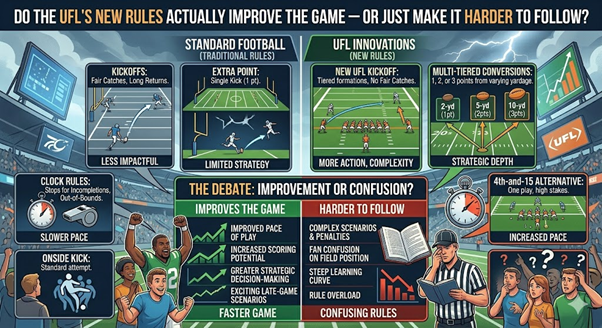
The UFL’s stated logic is easy to understand. If a football league wants attention, it needs scoring, pace, and uncertainty. That is the philosophy behind the four-point field goal, which rewards any successful kick from 60 yards or longer with an extra point compared with the standard NFL value. It is also the thinking behind the punt restriction, which removes one of the most conservative decisions a coach can make once the offense crosses midfield. The league is clearly trying to force action rather than allow teams to settle for field position and caution.
From a viewing perspective, that makes a certain amount of sense. Football is often at its best when teams are forced to take risks. If a defense knows a punt is off the table, the fourth-down decision becomes more dramatic. If a 60-yard field goal is worth four points, suddenly a long-range kicker becomes more than a specialist; he becomes a real game-altering weapon. That creates late-game intrigue and more visible strategic choices. The UFL is betting that fans want more of those moments, not fewer.
Why the rules can improve the game
There is a real argument that the new rules improve football by making it more honest about risk. Under the old system, teams often punted simply because that was the safe option, not because it was the most interesting one. The UFL is trying to remove that safety valve. Once a team crosses midfield, it has to behave as if it is trying to win the drive rather than merely survive it. That can lead to more fourth-down attempts, more creative play-calling, and fewer possessions that die quietly on a routine punt.
The one-foot-inbounds rule also fits that same logic. By adopting the NCAA standard instead of the NFL’s stricter two-feet requirement, the UFL makes catches a little easier to complete and a little easier to judge. That can help passing production, reduce borderline incompletion debates, and speed up the flow of the game. It is a small rule in isolation, but together with the rest of the package it pushes the UFL toward a more open, more offense-friendly version of football.
The updated overtime and post-touchdown system adds to that sense of movement. Instead of the familiar NFL-style structure, teams now alternate from the five-yard line in overtime, and touchdowns come with multiple conversion choices, including a 33-yard one-point kick and longer scrimmage-play options for two or three points. In theory, that creates more drama and more tactical variety. In practice, it also means that nearly every scoring sequence asks coaches to make more decisions than they would in a traditional league.
Why the rules can also make football harder to follow
The problem is that a league can become more exciting and more confusing at the same time. The UFL’s new structure asks viewers to understand more moving parts: when a punt is legal, how much a long field goal is worth, what the conversion options are, how overtime works, and why a team might now choose one aggressive option over another.
That learning curve matters. Football is already a complicated sport, but most fans understand its basic logic because the NFL has standardized it for decades. The UFL is asking viewers to watch a game that still looks like football but behaves differently in crucial situations. A kickoff, a short-yardage situation, a red-zone drive, and a late-game field position battle all now contain altered logic. That can be fascinating for dedicated fans and analysts, but it can also make the game feel less intuitive for someone who just wants to sit down and follow the action.
The tush push ban is a good example. In the NFL, the play has become a recognizable, if controversial, part of the modern short-yardage conversation. The UFL has eliminated it entirely. That may be a cleaner football decision from the league’s point of view, but it also removes a familiar reference point for viewers. The same goes for the punt rule. Fans do not just lose a strategy; they lose a way of reading the game.
The deeper issue: innovation versus clarity
The real tension in the UFL’s rule set is not whether the changes are bold. They are. The question is whether boldness is enough. A football league can absolutely survive on innovation, but innovation has to remain legible. If every important decision now has a separate scoring twist or procedural exception attached to it, the game risks turning into a rules demonstration instead of a sport that feels instinctive to watch.
This is why the UFL is such an interesting case. The league has chosen to prioritize action over familiarity, and that may be exactly the right instinct for a spring football property trying to separate itself from the NFL. But separation comes with a cost. The more the UFL changes, the more it has to explain those changes.
UFL’s new model in one look
Rule area | Traditional football | 2026 UFL approach |
Long field goals | Always 3 points | 60+ yard field goals worth 4 points |
Punting | Allowed at any field position | Restricted inside the opponent’s 50 until late in halves |
Short-yardage pushes | Legal in many forms | Tush push banned |
Receptions | Two feet inbounds | One foot inbounds required |
Overtime | NFL-style structure | Alternating attempts from the five-yard line |
So, does it actually work?
The honest answer is that it depends on what you value most. If you want a football product that produces more decisions, more risk, and more scoring pressure, then the UFL’s rules are a real improvement.
If, however, you value clarity, continuity, and the ability to watch a game without constantly recalibrating the rulebook in your head, the UFL’s changes can feel like clutter.
What is already clear is that the league is not trying to play it safe. It wants to be seen, debated, and, above all, different. And in a crowded football landscape, that may be the most important rule of all.