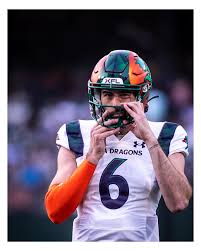
When quarterback Ben DiNucci was released by the Denver Broncos last week, the rumor mill went into overdrive, speculating he would be signed by a UFL team, ahead of the playoffs. The prospect was an exciting one. During his time with the XFL Seattle Sea Dragons, DiNucci led the team to the playoffs with a 7-3 record and posted a league-best completion percentage of 272/374 passes for 2,671 yards with 20 touchdowns and 13 interceptions. DiNucci had a solid ground game and added another three rushing touchdowns that season.
Fans were excited at the thought of DiNucci returning to spring football and with the playoffs looming in just a few weeks, the timing couldn't be better. But just as rumors began to speculate as to which team he would join, DiNucci announced on X (@B_DiNucci6) that although he'd been contacted by UFL teams and appreciated the fans' support, he would not be joining the UFL this year.
However, in a subsequent post, DiNucci left the door open to return to spring football in 2025 under a vastly different situation; where he would be both the starting quarterback and owner under a new expansion team. DiNucci's ideal scenario envisioned a return of the Seattle Sea Dragons where he would become one of the investors purchasing the franchise. Even for a league already known for innovation and rewriting the rule book, DiNucci's dream of a dual role of player /owner is an eye-popping stretch.
But is there a precedent for athlete ownership and could it happen as part of the UFL's bid to expand the league? Although it's unlikely to happen in the NFL, the possibility does exist in other professional sports. Dreaming of a dual role like George Halas enjoyed with the Bears in the 1920s, recently drafted Chicago Bears quarterback Caleb Williams has been very vocal about wanting an ownership stake in the franchise.
Unfortunately for Williams, the NFL operates quite differently today from the Halas era. The NFL's collective bargaining agreement limits a player's compensation to his value under the terms of his contract as an athlete. Any deviation from the terms of this agreement would violate the NFL Player Contract. All previous attempts to circumvent the wage/salary cap stipulation through add-on bonus earnings have failed.
There are situations however in other professional sports where owners have been allowed an ownership stake in the teams they play; most notably the agreement Lionel Messi signed with Inter Miami. Messi's contract allows him to function as a part owner of the team, but only after he has retired from being an active player.
In 1999, two years after retiring from the NHL, Mario Lemieux purchased the Pittsburgh Penguins. Renouncing his retirement in 2000, Lemieux returned to the ice and continued playing for the team until 2005. Today, he is still a minority owner in the club.
Current NBA rules previously prohibited athlete owners such as Michael Jordan (Charlotte Bobcats) and Magic Johnson (LA Lakers) from playing for their teams while acting as owners. The large financial stakes involved in the hugely profitable NBA and NFL franchises pose an inherent conflict between the owners and the athletes that could result in antitrust claims.
However, the UFL is not the NFL where an NFL's rookie minimum base salary in 2024 is $795,000. Player compensation in the UFL does not come close to the average multi-million dollar contracts signed by restricted free agents this year of $3.116 million.
Considering that the XFL was initially conceptualized by Dany Garcia who put together a consortium of buyers with Dwayne Johnson and Red Bird Capital to purchase and establish the league as a stand-alone sport that prides itself on innovation and forward-thinking, it might not be that far of a stretch to envision a time when players own a piece of their team. If Green Bay Packers fans can purchase ownership shares in their team, restructuring UFL player contracts to allow a small ownership stake to share in the franchise revenue isn't so far-fetched.