
The United Football League announced yesterday that it is departing from the Birmingham and Houston markets as part of a strategic market realignment. Co-owner Mike Repole framed the decision as disciplined long-term vision guided by three principles he has repeated since day one: the right market, the right-sized venue, and a passionate fan base.
The scrapping of Birmingham and Houston as UFL markets comes less than 1 year after Repole spoke very highly of the longevity of the Birmingham Stallions on a Birmingham radio station, WJOX. “I think I’m positive that as long as there’s a UFL, and there will be, the Birmingham Stallions will be part of it,” he said.
He called them the Dallas Cowboys and Pittsburgh Steelers of spring football, a dynasty that fans should support like one. He promised to be at the home opener. He challenged the city to show up. He said the Stallions were part of the league’s long-term plans. Eleven months later, the Stallions are gone, with the size of the venue being blamed as the reason.
The Same Disposable-Campsite Mentality, Expanded
Last offseason, the league uprooted Michigan, San Antonio, and Memphis. It publicly floated moving the three-time champion Stallions, then begged Birmingham fans to buy season tickets and deposits to keep the team alive. Supporters answered. The league answered them by redrafting the entire roster (despite promising not to), driving out Coach Skip Holtz, and now packing the franchise up entirely.
Ownership decided the stadium was too big. Houston receives the softer version of the same speech. The league admits it “did not give this market the consistency it deserved” because of venue changes, name changes, and shifting approaches, making it difficult to build lasting momentum. Now the league solves its problem of instability causing road bumps to lasting momentum by adding even more instability to the league by moving 2 more franchises this offseason. In 2 offseasons, 5 of the 8 franchises will relocate.
Create the chaos, then use the chaos as the exit ramp.
Attendance Down Across the League
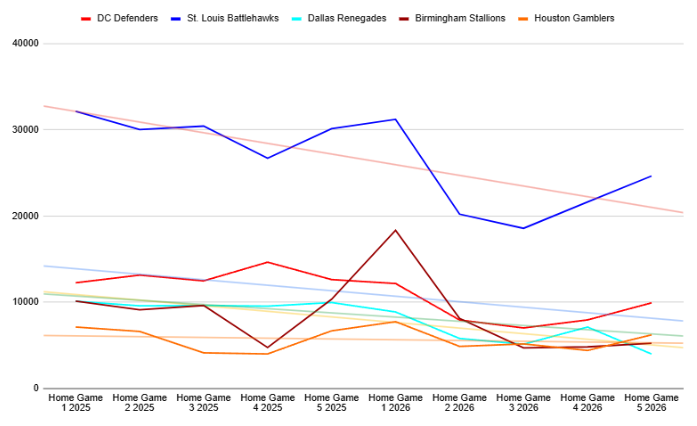
This is the same self-sabotage that emptied the stands in 2026. Attendance already collapsed across the five returning cities. Even the defending-champion Defenders had their worst season yet in attendance as the team they beat in the title game, the Michigan Panthers, no longer existed.
DC Defenders: 13,026 average in 2025, 9,000 in 2026 (–31%)
St. Louis Battlehawks: 29,537 in 2025, 23,239 in 2026 (–21%)
Dallas Renegades: 9,947 in 2025 (playing in Arlington), 6,185 in 2026 in Dallas (–38%)
Birmingham Stallions: 8,794 in 2025, 8,248 in 2026, but the real story is the free-fall after the opener (18,340 → 8,120 → 4,705 → 4,824 → 5,253)
Houston Gamblers: 5,712 in 2025, 5,683 in 2026
Broken Promises Beginning to Accumulate
After the 2025 season, the league stated clearly that all team rosters would remain unchanged. That promise lasted about a month. In December, the league blew up every roster again, bringing the second full reset in three seasons.
Now this offseason we are seeing the Birmingham Stallions uprooted despite less than 1 year ago it being stated that their existence would be synonymous with the existence of the UFL.
The UFL is not a trustworthy product to customers when it is not honest to the public. Relocating 5 of the 8 franchises signals to fans everywhere, don’t get too attached.
The On-Field Product Is Collapsing Right Alongside the Markets
While ownership chases theoretical perfect markets and perfect venues, the actual product is deteriorating in plain sight. There was a lot of hard-to-watch football this past UFL season regarding the passing game. This was also reflected in PFF passing grades. In prior seasons, it was common to see multiple quarterbacks post elite or high-70s/80s grades.
In 2026, those numbers evaporated. Across the quarterbacks who actually played significant snaps, high passing grades became the exception rather than the rule. Most sat in the 50s, 40s, or lower. A handful cracked the mid-60s or low 70s. Elite or even consistently good passing grades were almost nonexistent.
The Temp-Agency Mindset Has Now Reached the Cities Themselves
Repole’s public philosophy has always been clear: the UFL is not a place for players who linger four or five years. The same logic is now applied to entire markets.
You cannot build long-term sustainability by continuously discarding the markets and players that already invested. You cannot market “local ties” and “community engagement” while treating both as provisional. Mike Repole has been a passionate and involved owner. But his over-involvement in restructuring everything relating to football operations, paired with 5 of the 8 teams relocating in less than 1 year’s time, has been damaging.
Fans in the remaining markets see the UFL flippantly relocate teams and know that it can happen to any team. It signals to fans not to get too attached, and many will choose to do something else with their time.
Declining Attendance Across the League Could Get Worse
Since the return of the XFL, we saw spring football take off particularly well in St. Louis, a market flippantly abandoned by the NFL with the relocation of the St. Louis Rams years ago. 2026 saw the St. Louis market have significant declines in attendance, as did the other returning UFL markets. With the UFL now relocating 2 additional franchises, the message could not be clearer to fans. Loyalty is a 1-way street and every fan base is expendable. I suspect this to cause a greater falloff in fan interest in 2027 than what was seen in 2026.
Related Articles
UFL's Shift From Pro League to NFL Temp Agency is Recipe for Fan Disengagement, Nov 2025
UFL Blacklists Fan Favorites RB Ricky Person Jr. and Frank Ginda: As Foreshadowed Months Ago, Apr 2026