
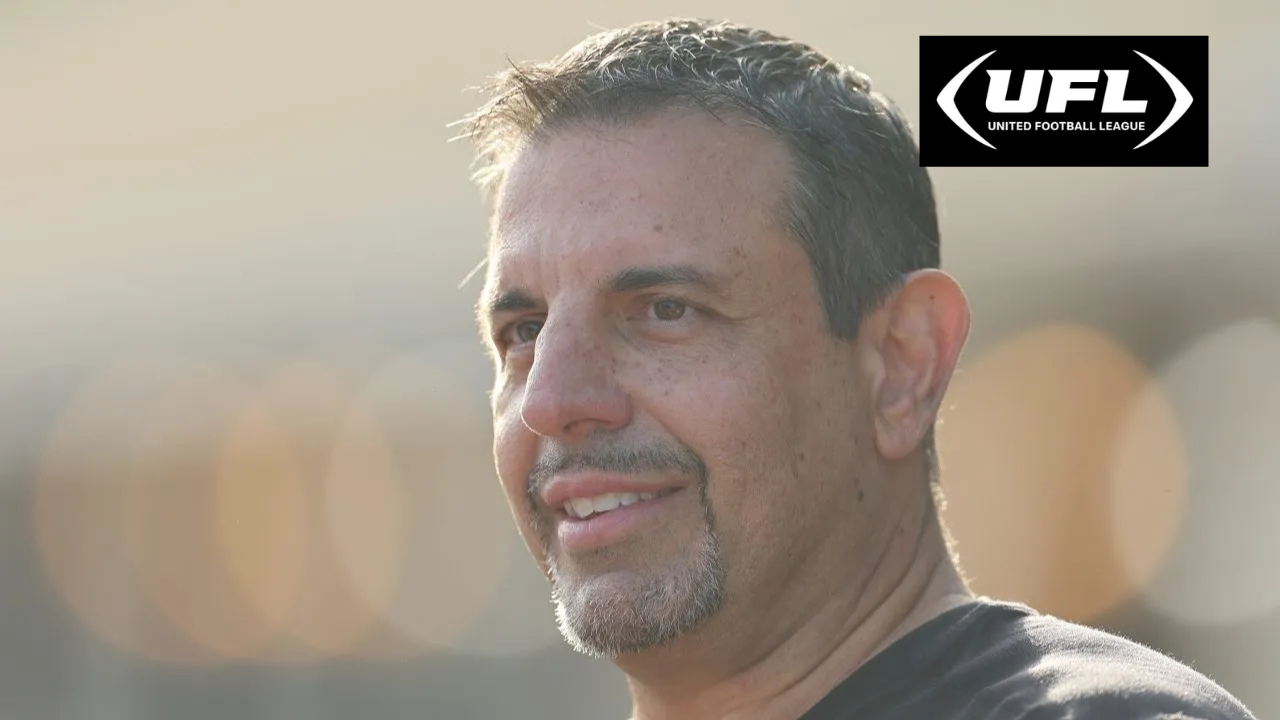
New UFL co-owner Mike Repole was front-and-center all last week at media availabilities in cities with new franchises. He held press conferences in Orlando, Louisville and Columbus, answering questions from both local and national media. In doing so, he's said almost all the right things.
Almost.
When Repole was brought aboard as co-owner, his focus seemed to be on marketing, business operations and building the brand of the UFL into something that can be profitable over the long term. His comments this week suggest he isn't staying in that lane, however, and is participating in if not making decisions in the football operations department; many of those decisions go against what management has said publicly about the UFL in the past.
Throughout the week, Repole referenced the idea that the UFL will be utilizing some form of territorial rights system that would allow, for example, Columbus to have the right of first refusal on all players from Ohio State University. This is not new to spring football: The XFL in 2001 had a territorial rights draft, and the Alliance of American Football did something similar for its quarterbacks.
The idea is that fans in the Columbus area would be more apt to support the UFL Aviators if they feature recognizable names with local ties. Though nothing appears to be set in stone, one suggested concept would have any schools within a 100-mile radius qualifying as being "protected" for that UFL team.
Those in the league player personnel department have resisted this idea in the past in part because they've been hyper-focused on parity amongst the teams. The quality of players coming out of these colleges may be wildly different depending on the region. That would give those teams with successful college teams around them a distinct advantage over their competition in the pool of players to choose from, the kind of advantage management has worked hard to avoid in the past.
While this falls under football operations because it affects roster building and the players in the league, one could argue that it's also in Repole's wheelhouse: The reason this is being implemented is to try to get more eyeballs on the product locally. With local talent, there might be more interest not only from the community, but it's also an easy story for the local media to report on. Media in UFL markets have not always embraced covering those teams.
The problem is, there's no evidence that any kind of territorial protections work to drum up interest in the market. Granted, the XFL in 2001 lasted just one season and the AAF all of eight weeks. If ownership previous to Repole's involvement really thought this would work, this would've already been implemented even if the personnel department objected. Sorry, but fans in the stands takes priority over equality of player movement.
If we were talking about superstar players, those that were top-shelf performers for their teams, then maybe I could see it moving the needle. When we're talking about spring football talent, though, we're really talking about players that were likely serviceable on those teams but were not major standouts. Are fans going to turn out for a Louisville Kings game to see a member of the Cardinals football team who was an honorable mention all-conference starting middle linebacker? I have my doubts.
More egregious is the Repole quote that had social media up in arms. From ESPN's article:
“If they have the drive and the passion and they want to make the NFL, and that’s their dream, then we want to help them. But if they’re looking for, ‘Hey, where’s my next check, or am I going to play next year?’ then this is probably not the league for you. And if you’re in this league four or five years, you probably shouldn’t be here. You should probably go into coaching or do something else.”
It's very easy to write this off as Repole talking, as a typical New Yorker, off the cuff and perhaps with a level of hyperbole. Taken at face value, this just seems like a bad idea. Worse, this came out around the same time that QB Luis Perez was reported by Pro Football Newsroom's James Larsen to have re-signed with the Dallas Renegades. Perez, who led all UFL quarterbacks in many passing categories last season, is heading into his eighth season of spring football. Is Repole suggesting telling Perez his talents are no longer wanted in the league?
Like the idea of territorial rights, this has gone against what ownership and the player personnel department have been on-record as saying in the past. They've framed the UFL as a place players can get tape and experience to get back into the NFL if that's their desire; if they just want to make a living playing the game they love even if their time in the NFL has gone, the UFL can be their home for that as well. Repole appears to be saying only the former is welcome in the new UFL.
There are a lot of "probablys" in the statement that allows for exceptions to this rule, such as for elite talent like Perez or Jordan Ta'amu (who just completed his fifth spring season), or for quarterbacks generally. But why handcuff team general managers at all? Why not allow them to sign the highest-level talent available regardless of age or experience? A league like the UFL should want the best on-field product possible to present to its fans; this has the potential to limit that quality.
I would argue players sticking around for multiple seasons is a good thing. It allows the public to identify players with the league, and more importantly, with the city and the community. This is the kind of local marketing Repole should be embracing and that would happen naturally under the current structure. If you have the kind of roster turnover that would result from this, the local markets won't be able to make a true connection with its players over the long-term.
One of the clap-backs I got on social media when I posted my thoughts on this was that it wasn't giving opportunities to others by allowing players to stay in this league forever. But having Luis Perez on the Renegades isn't preventing Luke Lehnen the opportunity to beat him out for the starting job. It's not preventing a player from being signed, attending training camp and proving he can beat out one of those veteran players.
Coaches and GMs alike should constantly look to upgrade their teams and if a player who has been around for a while isn't cutting it anymore then they should move in a different direction. Competition is good! It's healthy! But the best players should play regardless of their age or years of experience. That's how teams have been built since time immemorial and the league shouldn't be in the business of playing lesser talent to worship the false idol "opportunity."
Why did Repole bring this up? As the ESPN article suggests, Repole wants the UFL to be a true developmental arm of the NFL. Currently, the UFL has walked the line of wanting its players to graduate to the NFL while also referring to itself as a stand-alone league. Repole apparently wants that philosophy to shift, but what does that look like in practice? How different would a UFL that embraces being an NFL developmental league be over one that wants to keep that designation at arms-length? Do the rules get changed to better mirror those in the NFL? Without the NFL's direct involvement, it probably doesn't change a lot.
Where it can change is what Repole talked about, capping the number of seasons he wants players to be in the UFL. The image of the player just in it for a paycheck that Repole painted in his statement seems grossly unfair to those who take the field every weekend. If not 100%, then 99.9% of the UFL players would take an NFL contract if offered and have that somewhere in the back of their mind when they're suiting up for UFL games. No one is going to completely close the door on that dream. His dismissive attitude to those who have put their bodies on the line for multiple years in the game - "you should probably go into coaching or do something else" - probably won't be looked upon fondly by players or the player's union, who might have something to say about this if it gets further than just talk.
There's no evidence these comments are part of a directive from Repole and it doesn't appear there's anything in writing in this direction - the recent signing of Perez would indicate there's not. But if these are Repole's ideas in putting his thumb on the scale of who can and can't be signed by teams, then we're heading down a potentially bad avenue for football ops.
The UFL has a lot of problems. Most people, Repole included, agree that the product on the field is not one of them. Is it perfect? No. But none of these suggestions laid out by Repole - territorial protections, aging out and the embrace of being a developmental league for the NFL - solve the problems that do exist. So Mr. Repole, with all due respect, do your thing in marketing and branding. Get out there and twist some arms to get people into these stadiums. Advertise the heck out of this league. But please, stay away from football ops.