
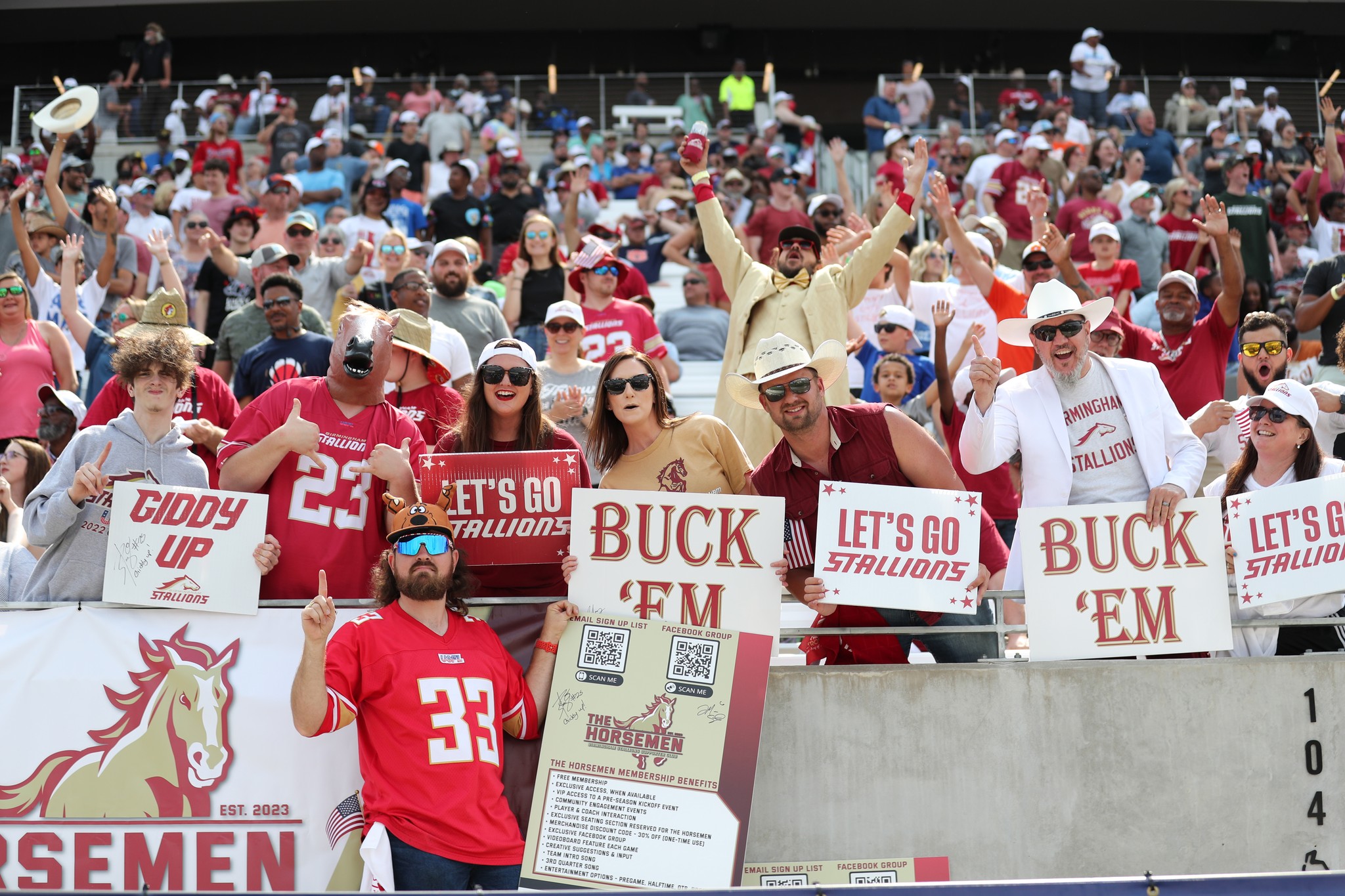
Within 72 hours of Mike Repole asking Birmingham for stadium ideas, the most-cited local answer came off the board. Hoover Mayor Nick Derzis said there is no plan to move the Stallions to the Hoover Metropolitan Complex "this year or next year." That closed the last plausible option inside metro Birmingham.
Repole set the standard himself. In his post on X planning the UFL's 2027 season, the co-owner wrote that a return to Protective Stadium "goes against one of the biggest principles we're building this league around……. smaller stadiums, packed houses, real energy and a true home field atmosphere." He has stated a target in the 15,000-to-25,000 range and a preference for soccer-style venues. He ended the post with a direct ask: "Birmingham, I am looking and need options and ideas."
Repole has not said the Stallions are leaving Birmingham. This piece does not report that. It tests what his own standard implies. We took him at his word, turned his criteria into a checklist, and ran every stadium in Alabama through it.
Repole's Checklist
The method is simple, and showing it is the point. Each judgment below comes from published capacities and publicly known calendars. Where a venue's spring availability cannot be confirmed from public records, we say so.
A venue has to clear five bars to keep the Stallions in the Birmingham area:
Capacity 15,000 to 25,000. Repole's number, not ours.
Spring availability, late March through early June.
Football setup: a football-configured field, sightlines, and locker rooms.
Broadcast-ready: truck access, lighting, and a press box.
Market viability: can it draw, and does the Stallions brand survive the move?
Running Every Stadium Through It
Here is every stadium in Alabama at UFL scale, measured against Repole's band.
Venue | City | Miles from Birmingham | Capacity | Fits 15K–25K? | Verdict |
|---|---|---|---|---|---|
Cramton Bowl | Montgomery | ~90 | 21,000 | Yes | Best fit on paper |
Burgess–Snow Field, AmFirst Stadium | Jacksonville | ~75 | 22,500 | Yes | Closest in-range venue |
Hancock Whitney Stadium | Mobile | ~260 | 25,450 | Just over | Viable, far |
Veterans Memorial Stadium | Troy | ~150 | 30,470 | No, over | Fails band |
Protective Stadium | Birmingham | 0 | 47,100 | No, over | The incumbent problem |
Legion Field | Birmingham | 0 | 71,594 | No, over | Fails band |
Hoover Metropolitan Stadium | Hoover | ~12 | ~10,800 | No, under | City declined |
Pete Hanna Stadium | Homewood | ~5 | 6,700 | No, under | Fails band |
Wicks Family Field, Joe Davis Stadium | Huntsville | ~100 | 6,000 | No, under | Fails on two counts |
The pattern shows up faster when you sort by why each venue fails.
Group A — Too big, and all of them are in Birmingham
Protective Stadium seats 47,100. Legion Field seats 71,594. Both sit well above Repole's ceiling, and both are in Birmingham. That is the core problem stated plainly: the only stadiums actually in the city are the ones that fail for being too large. Birmingham built its venues for the SEC and for the Magic City Classic, not for spring football. A Stallions home average of 8,248 in a 47,100-seat building leaves nearly 39,000 empty seats. That is the "empty stadium" look Repole has said he wants to avoid.
Group B — Too small, including the one that looks perfect
Three venues fail for the opposite reason. The Hoover Met holds about 10,800 for baseball. Pete Hanna Stadium at Samford holds 6,700. And Huntsville's Wicks Family Field holds 6,000.
Huntsville deserves the most attention, because on paper it is the closest thing in Alabama to what Repole describes. It is a soccer-first venue, renovated in 2023, home to Huntsville City FC of MLS NEXT Pro, and a 2023 SportsTravel Award nominee for best new or renovated venue. It fails anyway, twice. Capacity is 6,000, cut on purpose from more than 10,000 in the soccer-first renovation. That is less than half Repole's floor, and below Birmingham's 2026 average draw. Huntsville City FC also averaged 3,654 fans in 2026, so the building's own tenant does not fill it. And the calendar collides head-on: MLS NEXT Pro ran from February 27 through September 20 in 2026 with no World Cup pause, in a building the soccer club controls. The UFL's spring window lands inside that season.
The Hoover Met is the one fans raised most, and the host city closed the door. Hoover Mayor Nick Derzis said this week there is no plan to bring the Stallions to the Met in 2027 or beyond. He pointed to the calendar: the Met has hosted the SEC baseball tournament for more than 20 years, and the UFL plays in spring, so the two collide. "There's no plan to move the Stallions this year or next year to the Hoover Met," Derzis said. On capacity the Met already fell short of Repole's floor. The scheduling conflict and the mayor's statement close it off regardless.
Group C — The ones that fit, and where they are
Three venues clear or nearly clear the band. All three are outside metro Birmingham.
Cramton Bowl (Montgomery), 21,000. Dead center of Repole's range and city-owned. Its marquee events — the Salute to Veterans Bowl and the AHSAA high school football weekend — fall in December, which at minimum does not rule out a spring tenant. It sits about 90 miles from Birmingham. Note: published capacity splits between 21,000 (Encyclopedia of Alabama, Wikipedia) and 25,000 (ticket vendors); either way it clears Repole's floor.
AmFirst Stadium (Jacksonville State), 22,500. The closest in-range venue at about 75 miles. The catch is that it is an active FBS campus stadium, which brings NCAA facility-use rules, spring practice, and May graduation season into play.
Hancock Whitney Stadium (Mobile), 25,450. The newest football facility in the state at UFL scale, and it sits 450 seats above a strict 25,000 ceiling — call it the top edge. The Senior Bowl's late-January date does not collide with a late-March UFL kickoff. The disqualifier is distance: about 260 miles from Birmingham.
The Pattern
Line up the results and the shape is hard to miss. Every venue that fits Repole's criteria is a relocation out of the Birmingham area. Every venue in Birmingham fails. There is no overlap, and it is not close.
That inverts how a stadium search usually reads. A search implies a solution exists to be found. Run the numbers here and there is no Birmingham-shaped answer at all. The criteria are doing the deciding, not the search.
The league has already tried the obvious in-house fix. Repole floated covering Protective Stadium's upper bowl to play the lower bowl in 2025, pitching a configuration around 24,000, and the UFL used a reduced setup in 2026. It did not solve the problem. The Stallions still averaged 8,248, and Repole's 2027 post makes clear he does not want to return to Protective Stadium in any configuration. That removes the one option that would have kept the team in downtown Birmingham. The only open question the league has not addressed publicly is whether any flexibility exists on the 15,000-to-25,000 band itself.
The BJCC's response fits a criteria-driven process. CEO Tad Snider said the authority has supported the Stallions from the first USFL season through the UFL transition and is proud to host the team at Protective Stadium. He did not describe any active talks about the team's future. A decision made upstream on Repole's rules would look exactly like that.
What Birmingham Is Worth
There is a real case for staying. Birmingham is the winningest franchise of the modern spring-football era, with two USFL titles and the inaugural UFL championship. That brand equity does not load onto a truck. Montgomery and Mobile are unproven for pro football and would start from zero.
The case against is the gate. The Stallions posted their first losing season in franchise history in 2026, at 4–6, and missed the playoffs for the first time. Attendance fell with the record. Birmingham's five home games drew 18,340, 8,120, 4,705, 4,824, and 5,253 — an average of 8,248, sixth in the eight-team league. The home opener carried that number. It came with a Gucci Mane halftime show and the novelty of the franchise's return, and the Stallions never came close to it again. Strip out the opener and the last four home games averaged 5,726, in the same range as Dallas and Houston at the bottom of the league.
The league context tightens the squeeze. The UFL's 2026 rebrand deliberately moved teams into soccer-specific stadiums — Columbus, Louisville, Orlando, Dallas, and Houston all play in venues in the 14,000-to-25,500 range. Birmingham is the last market still playing in an outsized building. With Repole targeting 16 teams by the mid-2030s, unsolved markets are slots other cities want.
Bottom Line
Alabama has three stadiums that match what Mike Repole says he wants. None is in Birmingham, and the nearest is about 75 miles away. That is not a stadium problem. It is what happens when a league writes rules that its oldest and most successful market cannot satisfy. The Stallions' fate was likely set the day those rules were written. What is happening now is everyone finding out.