
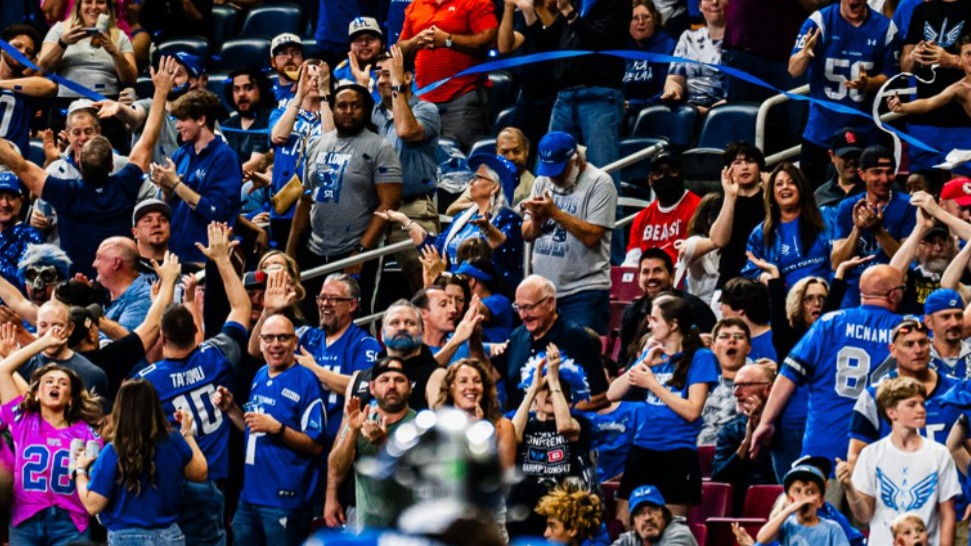
The prevailing narrative around the key business metrics from the UFL's 2026 season is that TV ratings were up and attendance was down. But UFL brass has disputed, on at least three different occasions, the fact that attendance declined from 2025 to 2026, even when publicly available data says otherwise. So who is right? Is it possible both are? That's what I wanted to find out. To help me try to make sense of the situation, I spoke to a former UFL executive knowledgeable about this area of the business (granted anonymity so as to speak freely on the topic), and a source within the UFL with knowledge of the situation (also granted anonymity to discuss the topic at hand). They came to two very different conclusions.
What we know
The UFL's attendance numbers are not a state secret. They are announced in the press box at each game and reported to the masses, usually online via social media. In comparing 2025 to 2026, total attendance through six weeks (more on that benchmark later) was down 52,923, or 17%. Through the 10-week regular season, the attendance reported was 67,902 lower in '26 than '25, a decline of about 14%. Taking into account the playoffs, the league was 77,527 short of 2025's total, holding the percentage drop steady at 14% (14.36% to be exact).
That's not a margin of error-type decrease; we're talking double-digits here. That's what makes the claims by UFL higher-ups so interesting to me. Which brings me to...
What they say
At two different points in the season, high-ranking UFL officials noted ticket sales were better in 2026 overall than they were the year before. Following week six, co-owner Mike Repole posted on X that "...we are UP in every major metric vs last year," and included "Tickets sold" and "Gate Attendance" under that banner. This despite the announced attendance through six weeks being 17% lower than 2025, as noted above.
Repole and UFL CEO Russ Brandon met with the media on the weekend of the United Bowl. Brandon took issue with the idea that ticket sales were down. His quote: "I saw a report today that ratings were up and ticket sales were down. That was wrong. Every metric on our ticket sales are up from last year."
More recently, in the UFL's press releases touting its new franchises for 2027 and 2028, the league noted "increase in overall ticket sales" in 2026.
What does the reported attendance number actually represent?
On social media, there's been some confusion over what the attendance number that gets reported out actually represents. You'll often see a response to a number met with criticisms like, "there's no way there were that many people at the stadium!" And that's likely true: The number associated with attendance does not count the number of people through the turnstile. It's the number of tickets distributed. Why do they do it this way? It's the highest possible number that can be reported, which most leagues, teams or venues would prefer to do for appearance purposes.
Now, tickets can be distributed a number of ways. Certainly, tickets purchased by consumers are included in that number, but so are tickets used as giveaways such as through local promotions, two-for-one deals, those set aside for players' families, sponsors, broadcasters, etc. In case there was any doubt, what the number represents was confirmed to me both by the former executive I spoke to for this story, as well as the UFL source.
How accurate IS that number, anyway?
The assumption is the number released to the public - the number of tickets distributed for a game - is accurate. But can we even count on that? At the end of 2023, I made several public records requests for attendance numbers, including tickets sold and actual people in the stadium, to local and state governments that owned or operated venues where the XFL played. The following is a chart I received from the University of Houston, which at the time housed the Roughnecks at TDECU Stadium.
DATE | TICKETS DISTRIBUTED | PAID TICKETS | SCAN COUNT |
2/18/23 | 14,298 | 7,859 | 8,346 |
2/26/23 | 13,383 | 7,043 | 7,112 |
3/5/23 | 12,937 | 6,847 | 6,962 |
4/2/23 | 13,104 | 8,808 | 7,622 |
4/15/23 | 11,300 | 7,869 | 6,116 |
4/29/23 | 15,321 | 6,659 | 9,062 |
None of numbers in the tickets distributed column match up to the generally accepted number of tickets distributed for those games, as listed on the league's Wikipedia page. For example, the first game is listed as 12,784 tickets distributed versus 14,298 in the chart above. Consistently, the University's own records are anywhere from 1,000-2,000 more distributed than the number listed on Wikipedia. At the time, the only source for XFL attendance was via insider and UFL News Hub writer Mike Mitchell, who claimed to get his number from league and venue sources. His Tweets are not credited or referenced for attendance on the XFL 2023 Wikipedia page. If the veracity of the actual number the public has to work with comes into question, then it becomes that much more difficult to read anything into attendance beyond what we see with our own eyes on TV.
And even that can be deceiving. Take for instance one game in Houston last year. The source with the league I spoke to said there was one game where fans on social media took particular umbrage with an announced attendance number, thinking it was way too high given what they were seeing on television. However, the source said it was a really hot day and many of the fans were taking cover in suites or under coverings, both of which were not shown by cameras on the broadcast. In other words: Don't always believe your lying eyes.
Can the difference be explained by the UFL giving away fewer tickets this year?
This seems to be the most popular - and perhaps only - explanation offered by outsiders as to how the tickets distributed number can be down, yet UFL leadership can also be correct that more tickets have been sold. Let's use Houston above as an example. 57% of the tickets distributed were sold. If we were to extrapolate that number across the league in 2025, that's about 307,500 tickets sold. Through all of 2026, the reported number of tickets distributed was 462,030. At that same 57% rate in 2026, the number of "tickets sold" would come to 263,357. So to beat that mythical 2025 number, the UFL would have to have sold about two-thirds of its tickets distributed, with one-third left as comps. This would require Houston to be consistent with the rest of the league in its sold vs. distributed number, as well as 2023 to look exactly like 2025 in that data. Both seem unlikely to be the case (in one example, the former league executive told me St. Louis once drew 40,000 for a game while they sold 36,000 of those tickets, a 90% sold clip).
The former executive I spoke with was highly skeptical of the idea that the UFL would've been able to sell two-thirds of the tickets distributed in 2026. In fact, the estimate the executive gave me was one-quarter sold to three-quarters comped, based on the low "show rate" at the games, notably in two of the biggest and historically successful markets, D.C. and St. Louis.
In order for this to be true, the league would've had to give away hundreds if not thousands of tickets per game in 2025 that they were not giving away in 2026. Remember, the difference in announced attendance was nearly 80,000 - for this neat-and-tidy explanation to work, all of those - and more - would've had to have been giveaways (I say "more" because that allows for some small percentage of tickets distributed in 2026 to be comps).
"It's impossible for both to be correct," the former league executive told me bluntly. "It's hard to believe they are trying to say this with the math you have there." This person pointed out the fact that there were buy-one-get-one offers for many games and others in which season ticket holders could bring a friend - those additional tickets would be counted as "distributed" in the attendance number made public but would not count as a ticket sold under the UFL's metrics.
"This isn't a fan base that buys tickets and doesn't show," said the former executive. "I think...the distributed number was heavily weighted in complementary tickets that just did not show up."
"The math just doesn't work..."
"It's just not possible," the former executive reiterated to me about the UFL selling more tickets in 2026 than 2025. In fact, the executive suggested that in Houston in 2026, they sold as little as one-eighth of the tickets sold in previous seasons. "There's not a chance they're anywhere near (numbers in the past), in their biggest markets they were down as well."
"What they were selling in Louisville doesn't replace what they lost in St. Louis and D.C.," the former executive continued. "And if anything, they were down in Houston, down in Frisco (for the Renegades)...the math just doesn't work." The source also noted the importance of the loss of San Antonio and Michigan from 2025 to 2026 in this discussion. The UFL left those markets not because of attendance woes, but rather because their stadiums did not fit Repole's vision of the league.
"If you're down in these two markets (D.C. and St. Louis) that drove, arguably, 60-to-70 percent of your business in the aggregate for all eight teams, you moved out of Detroit, which was up, you moved out of San Antonio, which was a strong market. You replaced it with Louisville and you replaced it with Columbus...you would've had to sell 30,000 seats in Louisville to make up for...San Antonio...and whatever you had to replace in the two markets you were down in D.C. and St. Louis."
...or does it?
The source I spoke with inside the UFL disagreed. He said two critical areas were up in 2026 over 2025: Tickets scanned and tickets sold, both at the heart of comments made by Repole and Brandon. Tickets scanned (referred to by Repole in his post as "gate attendance") accounts for the actual amount of people that came to the games, using tickets comped or sold. This person told me this was one of the most important data points for the league.
The UFL source also confirmed that the difference in the numbers can indeed be accounted for in the difference in complimentary tickets given away in 2025 and 2026. Because the league was in bigger stadiums in 2025, it allowed more room for comps to be distributed. This person also suggested fewer comps for the new franchises in Orlando, Louisville and Columbus. The idea is that a much higher percentage of tickets distributed in those locations would be of the sold variety because those franchises are new and interest would be higher in those cities. That could potentially offset attendance declines elsewhere in the league.
What can be done to increase attendance in these cities?
Regardless of whether or not the UFL actually sold more tickets in 2026 than in 2025, it's clearly an issue that needs improvement. Repole has moved two markets again this off-season, due in part to lagging ticket sales there, and he has announced a rededication to cities like St. Louis and D.C., that have had their attendance slip the past few seasons.
I asked the former executive knowledgeable about this area of the business what the UFL can and should do to stanch at least the perception of the downward slide of ticket sales across the league. "I think staffing both on the total number of sales representatives and the director at each team versus now a director for every two, has caused real challenges," the former executive told me. "There also continues to be uncertainty with the schedule and dates not really coming out until 60 days or less prior to the season."
The constant change may have permanently eroded some of the fanbases in these markets. "You've eaten away at the liability of the league from a trust and credibility factor with the fan because you've got people that have done this now for three or four years and you can't come back anymore because of the way you've treated them," the source said. "And St. Louis, that's the issue. They love going to those games in St. Louis. There's nothing else to do there from a football perspective. It's a badge of honor. And at the end of the day, they've done everything to make people not want to come back by the way they've priced things, by the way they've stuffed games into that market. I mean, that city's had almost one-and-a-half times the games over the last four years as any other."
Summary
Whether tickets were up or down, one thing management has made clear is that they're not satisfied with the attendance numbers league-wide and will continue chipping away at the markets - or moving them altogether - until there are substantial increases. Spring football fans have heard executives for years claim the importance of finding ways to increase the number of butts in seats, only for very little to be done. Hopefully the team in place in the UFL's front office today is the one to finally accomplish this.